AWS EDP & PPA Negotiation: Discounts and Exit
By Rostyslav Myronenko, holder of 14 active AWS certifications.
, updated . 16 min read
If your AWS bill has grown into seven figures, your account team has probably mentioned the AWS Enterprise Discount Program (EDP) or a Private Pricing Addendum (PPA). Both refer to the same thing: a private pricing contract where you commit to a level of AWS spend over several years, and AWS gives you a discount in return.
It can be a good deal. It can also lock you into a commitment that no longer fits your architecture two years from now. This guide explains how an EDP works, who qualifies, and how to prepare for and negotiate the PPA contract with AWS. If you want help preparing, I offer AWS EDP negotiation: I model the commitment and write the negotiation brief, and your team leads the sessions with AWS.
Getting the most out of an EDP or PPA negotiation takes some prework. The first thing to check is what counts toward the commitment: promotional credits usually don't, and since May 2025 only Marketplace SaaS that runs entirely on AWS does. Both rules are covered below.
What is AWS EDP?
The AWS Enterprise Discount Program (EDP) is a contract between your company and AWS, also called an EDP agreement. You commit to spending a certain amount on AWS over a fixed term, usually several years. In exchange, AWS applies a percentage discount to most of your eligible AWS usage.
A few characteristics define it:
- It is a spend commitment. You commit to dollars, not to specific instances or services.
- The discount is broad. Unlike Savings Plans or Reserved Instances, it applies across most AWS services on your bill rather than one service family.
- There is no public price list. Terms are negotiated and depend on your spend, growth, term length and what else is in the deal.
- Shortfalls are your problem: if you consume less than you committed, you still owe the difference.
Shortfall is usually settled per contract year: spend less than that year's commitment and you pay the difference. The two private pricing addenda in the public record, MiX Telematics in 2017 and VTEX in 2024, both work that way. A single settlement at the end of the term has to be negotiated; neither public addendum contains one.
AWS EDP vs PPA: is there a difference?
You will see both terms, and vendor blogs often treat them as separate programs. In practice, they have converged.
| EDP | PPA (Private Pricing Addendum) | |
|---|---|---|
| Historically | A cross-service discount: one percentage off most of your AWS bill | Service-specific pricing: a negotiated rate for a particular service or usage type |
| Today | Usually signed as a PPA | The addendum that holds the negotiated pricing, and can include both |
| On your bill | EdpDiscount line items in the Cost and Usage Report | PrivateRateDiscount line items |
Today, AWS contracts generally just say "private pricing" or PPA, and a single agreement can contain both a cross-service discount and service-specific rates. The distinction is mostly an internal AWS detail that leaked into customer vocabulary.
The question worth asking is which discounts are in your agreement: a blanket discount, service-specific rates, or both. AWS EDP vs PPA covers which of the two suits your bill.
What is an AWS PPA?
PPA stands for Private Pricing Addendum. It is the addendum that adds negotiated pricing to the agreement governing your AWS accounts, and you will also hear it called a private pricing agreement. The two addenda in the public record, MiX Telematics in 2017 and VTEX in 2024, show what one holds: a spend commitment per contract year, the list of eligible services, the discount, and what happens to a shortfall.
EDP, PPA and the AWS Enterprise Agreement
A third term turns up in procurement: the AWS Enterprise Agreement. It is the negotiated version of the standard AWS Customer Agreement that large customers sign. It covers the legal terms (liability, data handling, termination and the like) and carries no discount of its own.
Private pricing then arrives as an addendum to whichever agreement governs your accounts. So when someone asks how to negotiate an AWS enterprise agreement, they usually mean two negotiations that run in parallel: the legal terms with AWS Legal, and the commercial terms (commitment, discount, credits) with your account team. This guide is about the second one. Bring procurement and counsel into the first from the start, because the commercial addendum sits on top of it.
Who qualifies for an AWS private pricing agreement?
AWS does not publish eligibility criteria or minimum commitments. The AWS enterprise pricing page simply points you to AWS Sales.
What matters in practice:
- Current annual spend, and how predictable it is
- Expected growth over the term
- Strategic value to AWS: migrations from another cloud or from on-premises, new workloads, AI usage
- Your alternatives, and whether AWS believes you have them
Public guides put the floor at about $1M a year of AWS spend (Last Week in AWS, nOps, CloudForecast), and some put it at $500k (Vendr, TechNative). This guide rounds that to €1M. The one agreement in the public record at that level, MiX Telematics in 2017, committed $1M a year for three years. AWS decides case by case. Both public addenda tie the commitment to contract years and to a list of eligible services.
To check yourself against the usual AWS EDP requirements, go through the AWS EDP eligibility checklist. It takes a few minutes and your answers stay in your browser.
How does an AWS EDP work?
On paper the structure is simple: a commitment amount, a term and a discount rate. How much the deal is worth depends on the details below.
Commitment and term
You commit to a total spend over the term, often expressed as an annual amount. Longer terms and higher commitments generally earn a better rate. They also increase your risk if your architecture or business changes.
A commitment can be flat (the same amount every year) or ramped (lower in year one, rising later). A ramp is worth asking for if you expect growth, because it keeps year-one risk low.
AWS prefers ramp commitments because they reduce AWS's own risk, but it's fine if you have decent control over your spending. A good practice is to establish a spend review on a three- or six-month cadence to track it and adjust the spending strategy if needed.
How big is the AWS EDP discount?
AWS publishes no discount tiers. Advisory benchmarks run from about 5% at a $1M commitment to 20% or more at the largest commitments (Redress Compliance, CloudForecast, TechNative), and the 2017 MiX addendum gave 9% on $1M a year. You cannot forecast your rate precisely. What moves it:
- The size of the commitment and the length of the term
- A flat commitment versus a ramp
- Growth AWS can see coming, especially migrations and AI workloads
- Whether AWS believes you have alternatives
The discount applies to eligible usage only. Marketplace purchases count toward the commitment but are not discounted. In the Cost and Usage Report the discount arrives as separate Discount line items, and AWS's own Cloud Intelligence Dashboards queries name them EdpDiscount for the blanket rate and PrivateRateDiscount for service-specific rates. Check them every month against what you signed.
What counts toward the commitment
Not every dollar on your invoice counts toward the commitment or receives the discount. Items to check explicitly in your agreement:
- AWS Marketplace purchases. Some third-party software bought through Marketplace can count toward the commitment, subject to rules and caps. Check the current rules for your contract.
- Support: whether your Support plan charges count, and whether they are discounted.
- Savings Plans and Reserved Instances: how your commitment discounts interact with existing commitments.
- Credits. Migration or promotional credits reduce your bill, but spend paid with them does not count toward the commitment (TechNative). The VTEX addendum goes further and excludes spend paid from a shortfall balance too.
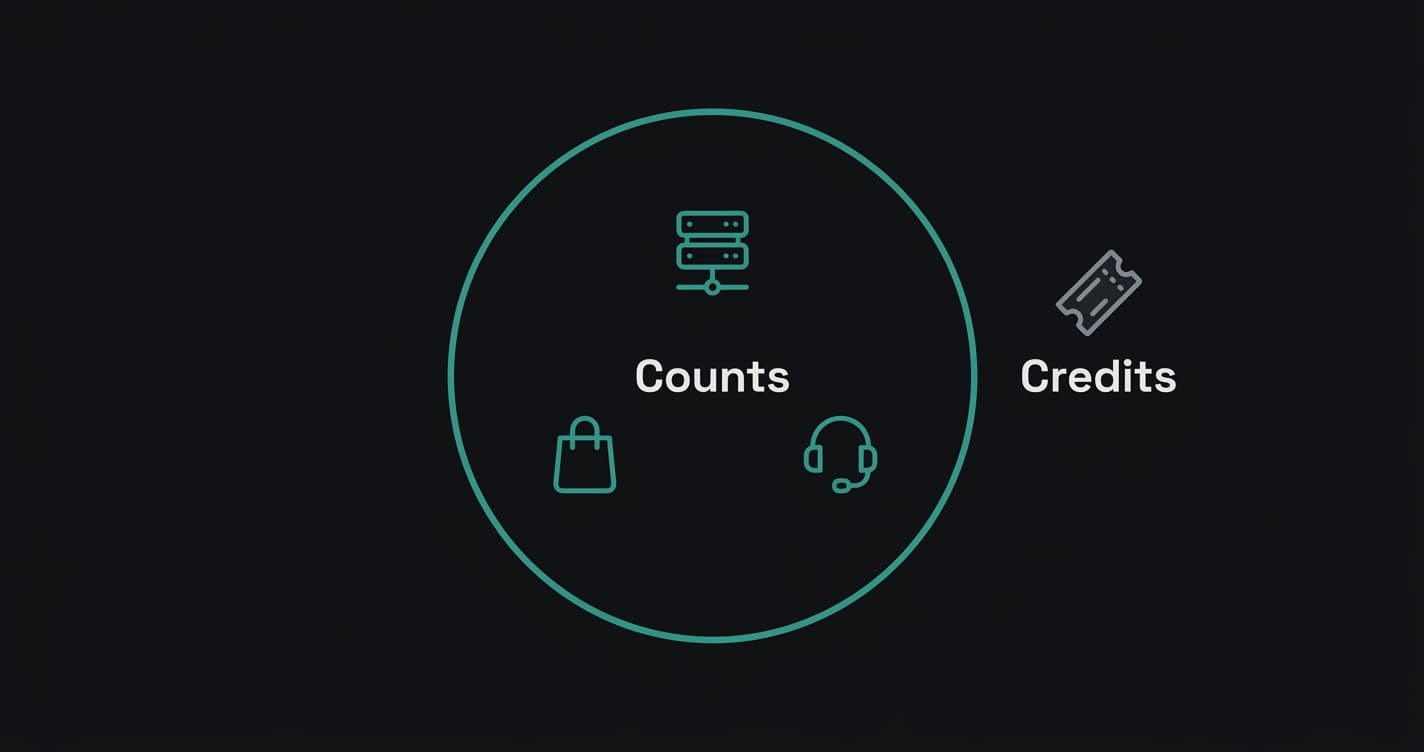
Some rules that are good to know:
- Marketplace spend counts toward the commitment but is not discounted (CloudForecast): a €1M purchase retires €1M of commitment at the vendor's price.
- The cap is set in the agreement. Contracts from 2022 on count Marketplace spend in full, up to 25% of the annual commitment; older ones counted 50 cents of each Marketplace dollar (Last Week in AWS, Duckbill). The VTEX addendum counts 50% of Marketplace fees.
- Since 1 May 2025 only SaaS that runs entirely on AWS counts, marked with a "Deployed on AWS" badge (AWS Marketplace blog). AWS decides eligibility product by product (AWS Marketplace buyer guide).
- The addendum defines the eligible AWS services, as a list or by pointing at AWS's exclusion list, so read it before counting on a product.
Is an AWS EDP worth it?
It is worth it when your eligible spend is steady enough to commit at or below a forecast you trust, the bill has had a cleanup pass, and the term is no longer than you expect your architecture to stay on AWS in its current shape.
It is not worth it when growth is a hope rather than a plan, when you are likely to move workloads off AWS during the term, or when Savings Plans would cover most of the same spend with less risk.
One bad year of shortfall can cost more than the discount saved that year. Say you commit €1M a year at 10%, and eligible spend after the discount comes in at €800k. You pay €200k of shortfall, while the discount saved you about €89k. Had you committed €800k, the same year would have cost no shortfall at all.
How to negotiate an AWS PPA contract
AWS's account team negotiates these deals every week, while most customers negotiate one every few years. Preparation is the part of that gap you can close. Your team runs the sessions with your account team, and most of your leverage comes from what you bring to the first one: a clean bill, your own forecast, a view on how the discount stacks with Savings Plans, and a list of asks beyond the headline rate. The four steps below cover that preparation, and the exit terms further down belong in the same round.
1. Clean up the bill first
Negotiating a discount on waste locks the waste in for years. Before you commit:
- Right-size over-provisioned instances and databases
- Remove idle resources and unattached storage
- Review data transfer and NAT gateway costs
- Get your Savings Plans and Reserved Instance coverage to a deliberate level
A systematic pass over the bill is where to look first. That pass is what my AWS Savings Implementation Sprint does, before any commitment is signed.
2. Build a realistic forecast
Your commitment should come from a forecast you trust, not from the number AWS suggests. Build it bottom-up:
- Baseline: current spend after the cleanup above
- Planned growth: new products, customers, regions
- Planned reductions: migrations, re-architecture, decommissioning
- Uncertain lines: AI and machine learning usage, which is the hardest to predict
Then commit below the forecast, not at it. The discount on the gap between commitment and forecast is rarely worth the shortfall risk.
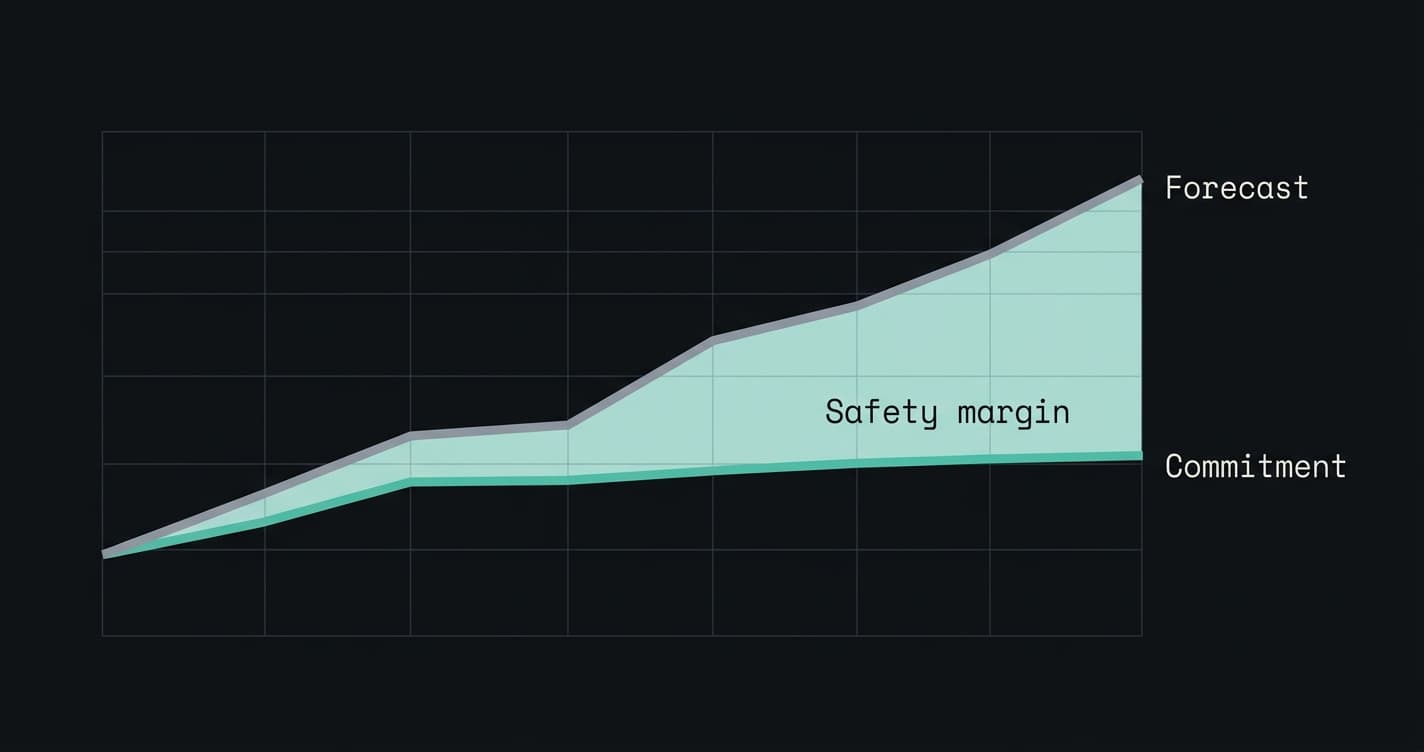
A defensible level is the P90 floor: the spend you are 90% sure to exceed. Build the forecast in eligible-spend terms: the post-Savings-Plan baseline, minus known decommissions and planned optimization, minus credits, with Marketplace at its capped and qualifying value. The discount itself reduces what counts, because the public addenda count what you actually pay after it.
3. AWS EDP vs Savings Plans: how they interact
A private pricing discount and Savings Plans stack in ways that are not always intuitive. Model your effective rate with both in place before you sign.
They are different kinds of commitment:
| EDP / PPA | Savings Plans | |
|---|---|---|
| You commit to | Total AWS spend over the term | A fixed amount per hour of eligible usage |
| Term | One to five years | One or three years |
| Covers | Most AWS services, plus Marketplace up to a cap | Compute, EC2, database or SageMaker usage, by plan type |
| Discount | Negotiated, never published; benchmarks run from about 5% to 20%+ | Published, up to 72% |
| If you use less | You pay the shortfall, measured per contract year | You pay the hourly commitment anyway |
Check in the agreement whether Savings Plan charges count toward the EDP commitment and whether they get the discount. That decides how much of each to buy.
4. Decide what else to ask for
The discount percentage is only one lever. Depending on your situation, you can also discuss:
- Ramped commitments instead of flat ones
- Migration or modernization credits
- Service-specific rates for your largest services
- Treatment of Marketplace spend
- Terms for what happens if you need to reduce commitment
Which lever matters most depends on the shape of the bill. When a few services dominate spend, a service-specific rate on those moves more money than a point on the blanket discount. A smaller footprint gains less from per-service rates, so credits and a ramp carry more weight there.
Exit strategy and true-down
Once you sign, the commitment holds for the full term. A true-down, which lowers the commitment to match what you actually use, isn't a standard right in these agreements. You have to negotiate it, and that is much easier before signing than halfway through the term.
How shortfall billing works
Shortfall is measured per commitment period, which is each contract year in both addenda filed with the SEC. When the period ends, AWS compares your eligible spend with the commitment and sends a one-time invoice for the difference.
Check three things in your agreement:
- Which spend counts. The public addenda count what you actually pay after the discount, with Marketplace at a stated share or up to a cap, and promotional credits do not count. Whatever you track during the year has to follow the same rules, or the shortfall will surprise you.
- What the payment buys. In both public addenda the payment is nonrefundable, and AWS applies it as a balance against later charges within the term. The VTEX addendum adds that the balance does not reduce a later shortfall and expires with the agreement, so it is not a credit toward the next commitment. Ask whether yours can carry into the next term.
- What happens to overspend. If you go over the commitment in year one, the excess doesn't count toward year two unless a clause says it does.
The three- or six-month spend review described above is where you see a shortfall coming while there's still time to act on it.
Reducing a commitment mid-term
Neither public addendum gives you a right to lower the commitment, and both bar termination for convenience during the term. What you can do depends on the size of the gap and how much of the year is left.
If the gap is small, bring forward spend you were going to make anyway. Savings Plans and Reserved Instances bought upfront are charged at purchase, so if your agreement counts those charges, they close part of the gap and leave you with capacity you'll use. Marketplace purchases work the same way up to the cap. In the example above, a €200k gap on a €1M commitment fits under a 25% Marketplace cap, provided you have that much software to buy and nothing else has used the cap that year. Only buy what you would have bought anyway: a Savings Plan you won't use is a second commitment with the same problem.
If the gap is large because a workload moved off AWS, a product was shut down or the business shrank, talk to your account team before the year closes. A customer who pays a large shortfall and then leaves at renewal is a bad outcome for AWS too, which gives you room to restructure. The documented options are a new multi-year agreement that replaces the current one (Duckbill), or a slightly higher commitment over a longer term (Last Week in AWS). Expect to pay for either with a longer lock-in or a lower discount.
Negotiating exit terms before you sign
You have the most leverage before the agreement is signed and again at renewal. Mid-term, the only thing you can offer AWS is new spend, such as a migration or a longer term.
Exit terms worth asking for:
- A ramp instead of a flat commitment, so the years you're least sure about carry the least risk
- Overspend in one year counting toward the next
- Shortfall converted into credits for the following year or the next agreement, so the payment isn't lost
- An adjustment clause for divestitures and acquisitions, so selling a business unit lowers the commitment with it
- A review point, for example at the end of year one, where both sides can revisit the commitment
- End-of-term settlement instead of per contract year, which neither public addendum contains
Put these on the table in the same round as the discount. Each may cost you some of the rate, and that trade is easier to judge when you can see the whole package at once.
Common mistakes
- Committing at the forecast instead of below it. Growth plans slip; commitments don't.
- Negotiating before optimizing. You get a discount on spend you should have removed.
- Ignoring the renewal. The next agreement starts from where this one ends. Know your position before renewal talks begin.
- Letting AWS build the forecast. Your account team's forecast is a starting point, not a neutral one.
An account team's forecast is built from what AWS can see: past usage and the roadmap you have shared. Anything it cannot see, such as a planned re-architecture or a workload leaving, is missing from it, and the commitment inherits the gap.
FAQ
What is an EDP in AWS?
An EDP (Enterprise Discount Program) is a private contract where a company commits to a level of AWS spend over a multi-year term in exchange for a discount on most AWS services.
What is the difference between EDP and PPA?
Historically, EDP meant a cross-service discount and PPA (Private Pricing Addendum) meant service-specific pricing. Today they are handled through the same private pricing agreement, which can contain both.
What does PPA mean in AWS?
PPA stands for Private Pricing Addendum: the addendum to your AWS agreement that holds the negotiated pricing, meaning the spend commitment, the term, the discount and any service-specific rates. Some people call it a private pricing agreement. A new EDP is usually signed as a PPA.
What does EDP mean in cloud?
EDP stands for Enterprise Discount Program, AWS's private pricing agreement for large customers. The term is specific to AWS: Microsoft's equivalent is the Azure Consumption Commitment (MACC), and Google's is a Committed Use Discount agreement. If someone says “EDP” without naming a cloud, they almost always mean AWS.
What is the minimum EDP for AWS?
AWS does not publish a minimum. Private pricing is typically discussed with companies spending around €1M or more a year on AWS, but eligibility depends on your spend, growth and negotiation. The EDP eligibility checklist walks through the rest.
Does an EDP replace Savings Plans?
No. Savings Plans and Reserved Instances are separate commitment discounts that can apply alongside a private pricing agreement. Model both together before deciding on commitment levels.
Can I negotiate an EDP myself?
Yes. Many companies do. The risk is information asymmetry: AWS negotiates these deals constantly, and most customers only do it every few years. An independent advisor who does not resell AWS can help you prepare the forecast and the asks.
What is an AWS enterprise agreement?
A negotiated version of the AWS Customer Agreement that large customers sign, covering the legal terms of the relationship. Private pricing (an EDP or PPA) is usually an addendum to it, so the two are negotiated together but are not the same document.
How do you negotiate an AWS enterprise agreement?
Clean up the bill first, build your own forecast, commit below it, and ask for more than the headline discount: a ramp, credits, service-specific rates and Marketplace treatment. Bring procurement and counsel in early, because the legal terms and the commercial addendum are negotiated in parallel.
Getting help with your AWS private pricing agreement
A private pricing agreement is one of the largest financial commitments a cloud-heavy company makes, and you live with it for years.
If you are approaching a new agreement or a renewal, I can help you prepare the numbers and the negotiation strategy through AWS Contract & Commitment Negotiation. I'm independent, with no reseller margin on your AWS spend.